


A store payment terminal fails during a peak buying window. A clinic cannot retrieve a patient record quickly enough for an appointment. A service desk queue grows while approvals sit in email. Growth across Toronto industries brings more approvals, invoices, resident or customer requests, privacy obligations, integrations, and response expectations. We see this as operational pressure first, and technology demand second. As a security-first managed services and business systems integration partner, we focus on reducing risk while making daily work clearer.
Alan McFarland, CTO, vCTO , Strategic Advisor for Digital Transformation at Edgeworx Solutions, notes: “Growth becomes measurable when governance, access, and workflow ownership are clear enough for teams to act quickly and prove control.
Turn Growth Pressure Into Control
Edgeworx Solutions helps Toronto organizations simplify systems, reduce risk, and keep daily operations moving as demand grows.
Early Signals Across Top Industries In Toronto
Growth shows up first in the queue: more service requests, digital transactions, protected records, and vendor dependencies. Retail teams need reliable store systems. Healthcare teams need protected information available to the right people. Financial services teams need evidence for access, vendor, and risk decisions.
Among the top industries in Toronto, municipalities and local governments face the same pattern as resident requests, records, approvals, and public accountability move through connected systems. Arts and culture organizations add donor, member, ticketing, and collections data.
We support industry-specific IT services, including Retail IT Services, and understand that regulated environments need practical governance, not paperwork for its own sake. Our work with leading Ontario arts and culture institutions, including the McMichael Canadian Art Collection and the Aga Khan Museum, reflects that balance: modernization has to protect records, support staff, and make engagement easier to manage.
Point-of-sale uptime affects sales. Patient information access affects appointments. Municipal service tickets affect response commitments. Donor records affect stewardship. Invoice approvals affect cash flow. Staff access permissions tie them all together.
Operational Pressure In Toronto Top Industries
A delayed invoice approval looks small until finance re-enters data, a manager misses the notice, and a vendor follow-up becomes another ticket. In Toronto top industries, growth turns workflow gaps into measurable delays: unresolved service requests, duplicated records, slow restore times, and unclear ownership when someone needs an answer.
Growing organizations need IT controls tied to business outcomes, not isolated technical fixes. We partner with hardware, software, and service technology vendors to design, manage, and protect enterprise information systems while supporting both legacy and modern environments. The aim is practical: clearer ownership, reduced downtime, stronger governance, and audit-ready recommendations connected to how work gets done.
|
Priority |
Business Impact |
IT Control |
|
Service request volume |
Faster response and clearer ownership |
Ticketing workflows, escalation rules, same-business-day response model |
|
Privacy and records handling |
Stronger compliance posture |
Access reviews, privacy assessment, policy mapping to PIPEDA, PHIPA where relevant, and HIPAA where relevant |
|
System fragmentation |
Cleaner workflows and fewer manual handoffs |
Business systems integration across finance, customer, resident, and operational platforms |
|
Backup and recovery |
Reduced downtime and audit-ready continuity |
Canadian data-resident encrypted backup and rapid restore planning |
|
Executive oversight |
Better investment decisions |
Fractional CIO and CISO advisory, CIS Controls, Technology Maturity Assessments |
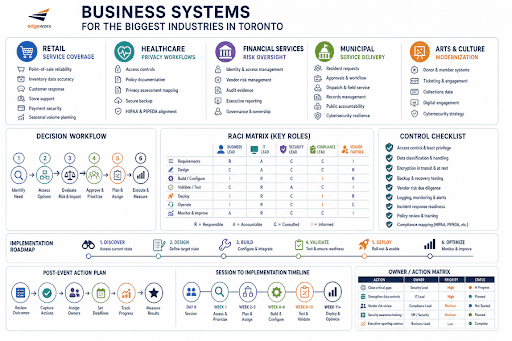
Business Systems For The Biggest Industries In Toronto
IT challenges become business challenges when systems do not match how work moves across teams, approvals, vendors, and records. For the biggest industries in Toronto, the right plan starts with workflow, then connects cybersecurity, privacy, backup, reporting, and support around that reality.
-
Retail service coverage: Point-of-sale reliability, inventory data, customer response, store support, payment security, and seasonal volume planning all affect revenue and service consistency. Our Retail IT Services connect support priorities to store operations, so uptime, access, and escalation are treated as operating controls.
-
Healthcare privacy workflows: Protected information needs access controls, policy documentation, secure backup, and practical privacy assessment mapping. We map assessments to HIPAA and PIPEDA where applicable so obligations become usable procedures for staff access, record handling, retention, and restore planning.
-
Financial services risk oversight: Identity and access management, vendor risk, audit evidence, executive reporting, and governance need consistent ownership. Fractional CIO and CISO advisory turns those requirements into board-ready decisions, with clearer evidence for access reviews, vendor responsibilities, and risk priorities.
-
Municipal service delivery: Resident requests, approvals, dispatch, records, public accountability, and cybersecurity gaps all meet at the service counter. We have discussed findings from the 2024 MISA Municipal Cybersecurity Survey as context for Ontario municipal cybersecurity gaps and challenges, with a focus on controls that improve service continuity and governance.
-
Arts and culture modernization: Donor systems, ticketing or member platforms, digital engagement, collections data, and cybersecurity strategy require careful modernization.
More articles you might like:
IT Priorities For Industries In Toronto
Modernization is difficult because staff must keep services running while systems, policies, and vendor relationships change. For growing industries in Toronto, sequencing matters: start with the work people already manage, then strengthen the controls around it.
-
Map critical workflows: Identify where tickets, invoices, approvals, dispatch, resident requests, customer requests, and records move between systems.
-
Assess security maturity: Use CIS Controls and Technology Maturity Assessments to prioritize access management, backup, incident response, and governance with audit-ready evidence.
-
Document privacy obligations: Align privacy and accessibility assessments to relevant standards such as AODA, PIPEDA, HIPAA where applicable, and sector-specific obligations.
-
Review recovery readiness: Confirm Canadian data-resident backup, encryption, restore timing, ownership, and test schedules.
Industry-aware IT support removes operational drag by aligning cybersecurity, automation, and planning to daily workflows.
Our capability areas include fractional CIO and CISO advisory, Voice AI and Omnichannel AI Managed Services, privacy and accessibility assessments, and Canadian data-resident backup.
Trusted IT Services Near You
A Practical Path For Toronto Industries
Growth is strongest when IT planning reduces risk, improves response, clarifies governance, and connects systems around real work such as tickets, invoices, approvals, records, and customer handoffs. As a security-first managed services and business systems integration partner, we help teams move from scattered fixes to practical modernization with options such as fractional CIO and CISO advisory, Canadian data-resident backup, and same-business-day response with SLA credits.
If a failed payment terminal, delayed record lookup, or stalled approval is already exposing the next workflow gap, contact Edgeworx Solutions for a focused conversation about priorities, ownership, and measurable next steps.